Have you ever wondered what’s up with cows chewing their cud? What is that stuff and why do they do it? Maybe you don’t even know what I’m talking about. That is perfectly ok because we are about to cover cud and more.

Let’s start with the fact that cows are ruminant animals, along with goats, sheep, and deer. A ruminant animal means they have 4 compartments to their stomach. They don’t have 4 stomachs, but rather it is 4 rooms that make up one stomach. Each “room” has its own special job and name. Before getting to that, let’s first go to the beginning–the mouth.

Ruminants do not have upper incisors, only lower. These are for plucking food. They do have pretty sharp upper and lower molars, though that grinds their food. These teeth are most useful the second time around. I realize that sounds really strange, but ruminants mostly swallow their food whole. They will regurgitate it to chew it again. I’m getting ahead of myself, though.
So, the cow has swallowed the hay. The food travels through the esophagus and hits the first compartment of the stomach–the rumen.
Rumen
This is the largest part of the stomach (holding 4-6 gallons) and is responsible for a lot of fermentation. Over 50-65% of starch and soluble sugars are absorbed here. Bacteria break down the food and cause carbon monoxide, methane, and hydrogen sulfide to form.
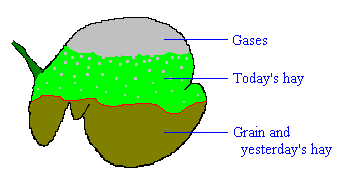
These gases build up which results in, well, a belch. More than a belch, though, it is the process of regurgitating the food to re-chew it. Yumm, seconds! Animals chew their cud many hours a day, usually when the animal is resting. Ever heard of the phrase “I’m just ruminating (thinking)?” After breaking down the food even more by chewing the cud, the animal swallows and the food goes into the reticulum.
Reticulum
Separated from the rumen by a flap of tissue, this part of the stomach looks like a honeycomb and works like a water filter to catch foreign objects that cannot be digested. 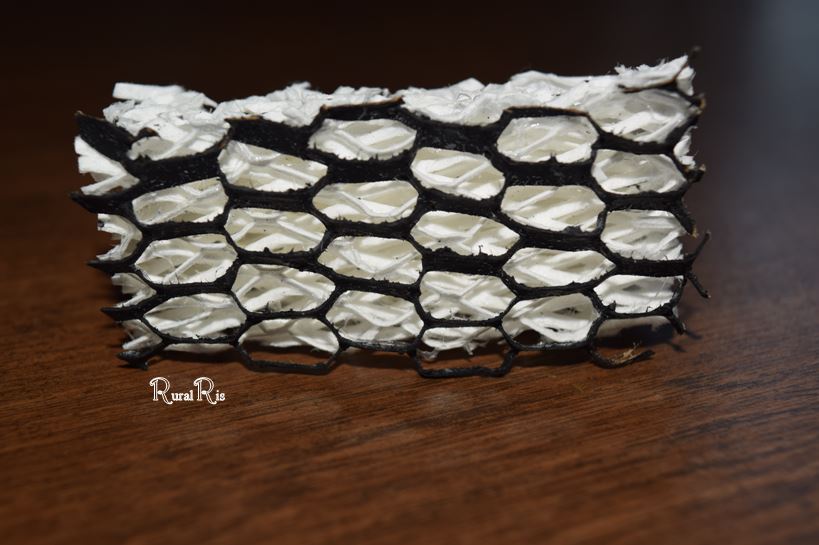 Because it catches things like metal or nails, it is often called the hardware stomach. These objects can puncture the reticulum and make its way to the heart causing hardware disease. Hopefully the animal just doesn’t eat “junk” food.
Omasum
After being sloshed around in the rumen and reticulum, it moves to the omasum. Here, a lot of the water is absorbed. This is a pretty big job, considering that the food that enters, is 90-95% water. The omasum is also called the butchers bible because it looks like it has a lot of pages.
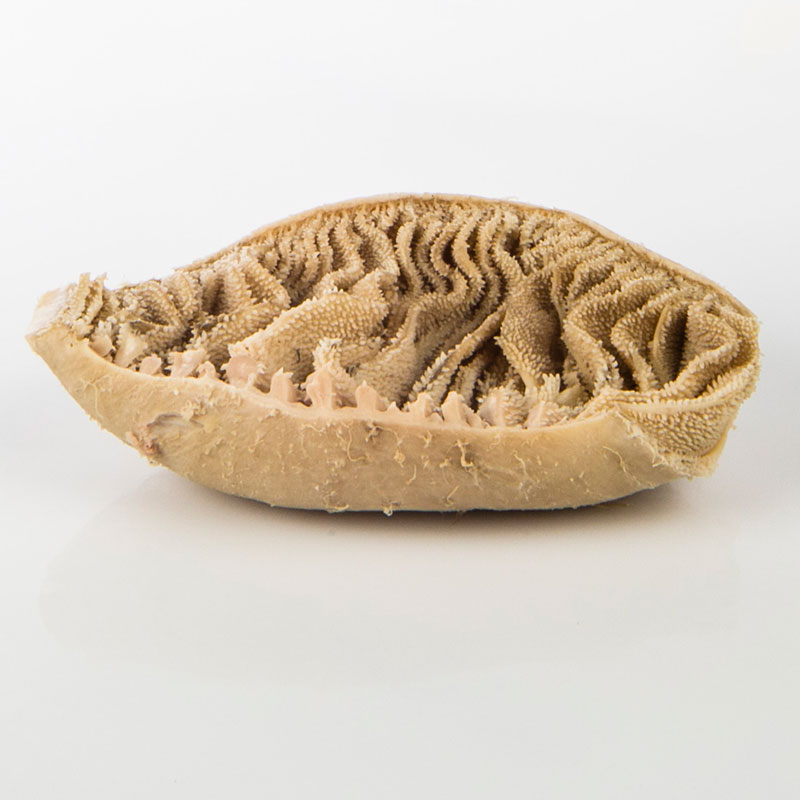
These pages create more surface are a to absorb the water before heading into the final chamber.
Abomasum
Welcome to the true stomach! The part of the stomach is most like humans, where hydrochloric acid breaks down the rest of the food. There are chief cells on the walls of the abomasum that secrete mucous to protect it from acid damage.
After the abomasum, food travels through the intestines and ends up in little balls of poop (sorry for the graphic mental image).
***
That, my friends, is why cows and other animals chew their cud. They are ruminant animals. Ruminants don’t start chewing their cud until a few weeks or months after they are born. Young ruminants have an esophageal groove that shoots milk straight to the omasum and abomasum. They can get their nutrients in a hurry that way. When they do start chewing cud, I don’t recommend getting cud on you or being near their faces when they burp. It is really gross and stinky.
Sources:
http://www.thebeefsite.com/articles/2095/understanding-the-ruminant-animals-digestive-system
http://www.vivo.colostate.edu/hbooks/pathphys/digestion/herbivores/rumination.html





 Rural Ris