Easter is right around the corner. I can practically hear the Easter Bunny’s hops in the distance Fun fact: I dressed up as the Easter Bunny for several years for a local group. I feel that I have a closer bond with the real Easter Bunny, now. Anyways, back to Easter shenanigans.
My family’s tradition is to color Easter eggs on Saturday evening with normal dye. We are all given strict instructions to only take a certain amount of eggs; however, every once in a while, there is a miscount. The creative juices get going, and our math skills waiver. Things happen, you know?
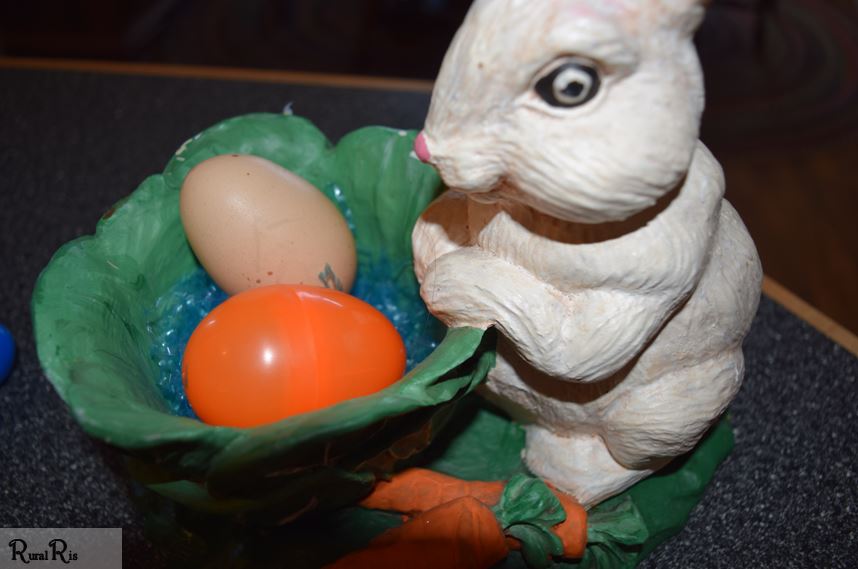
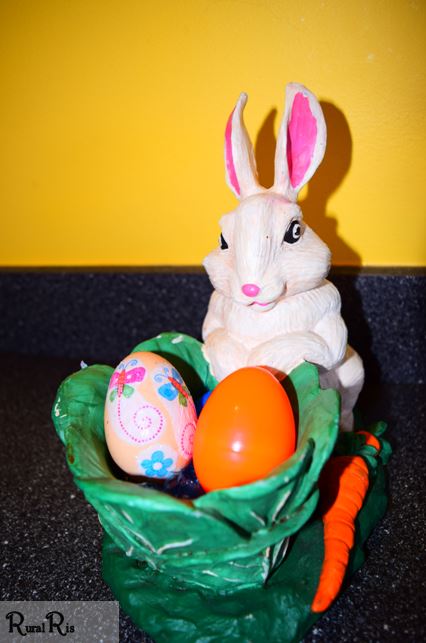
Easter is the one time where we buy eggs. Our chickens graciously provide an abundance of eggs to our family and others. We will use a couple of their eggs for dying, but they are all brown, and the colors aren’t as vibrant. So, we buy big white eggs from the store. I did get a head start on the egg decorating this year, and thought I would share what I did with you.
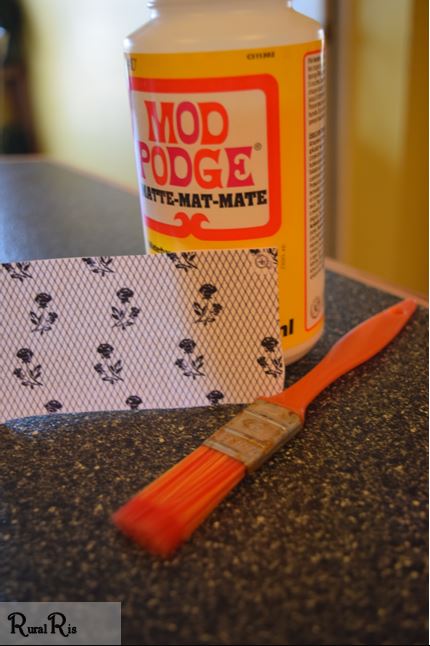
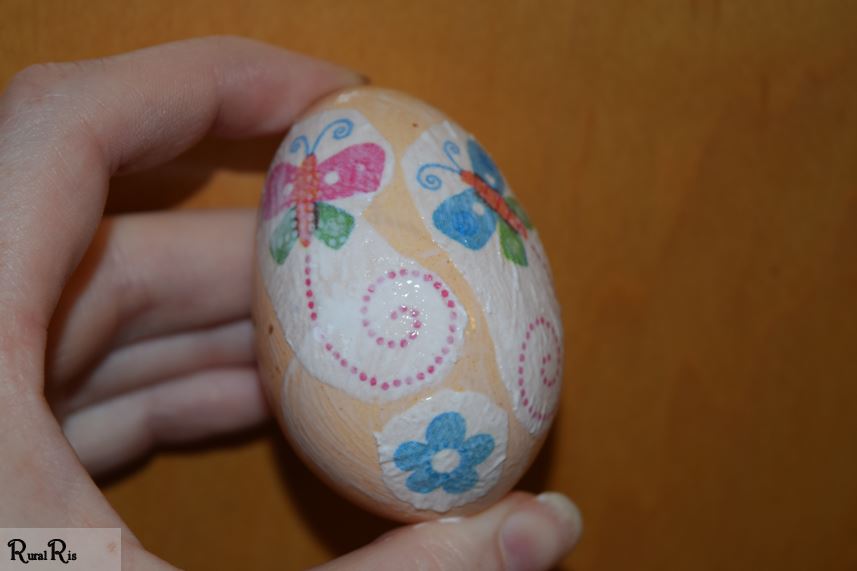
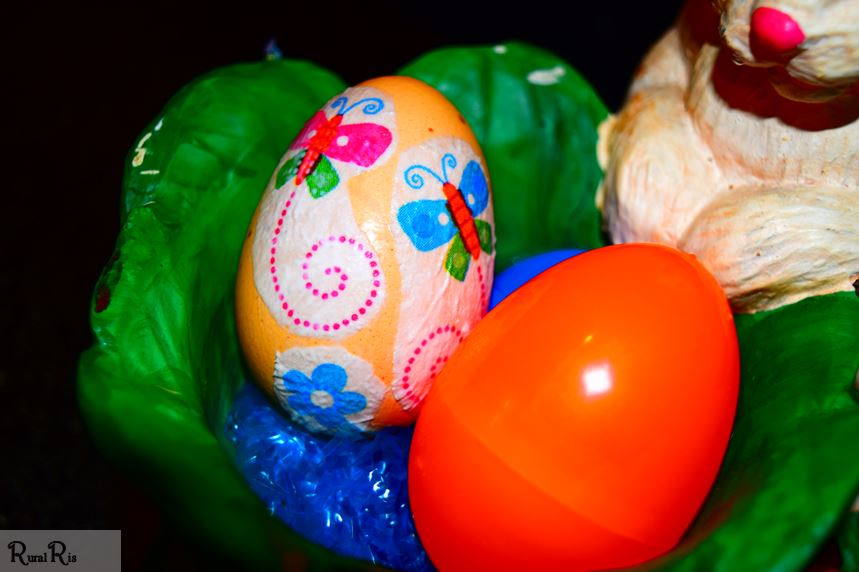
I didn’t use any dye, just a bit of Mod Podge and a napkin. There is so many things you can do with this, and perhaps you will try it too. It was ideal for my home grown brown eggs for sure! Without any more waiting, here is the Non-dyed, Mod Podge Easter Egg.
Supplies:
Paint brush
Modge Podge or equal parts craft glue and water mixed together
Egg
Napkin or paper (the napkin works best with its flexibility)
Instructions:
If you are taking your egg straight from the fridge, it will probably sweat a bit, so be sure to dry it off well.
Cut your napkin into whatever pieces you want to put on your egg.
Next, brush a bit of Mod Podge onto the egg. Not a lot at all. Take your piece of napkin and lay on top of it. Brush another layer of Mod Podge on top of the napkin.
While we are letting it dry, let’s talk about some egg statistics:
Statistics:
As of December 2014…
There are about 306 million layers.
They averaged 79.9 eggs per 100 hens
Iowa is the top producer of eggs
There are around 175 egg producing companies that have flocks of 75,000 hens or more and these represent 99% of all layers in America.
66 egg producing companies have over 1 million layers which represents 87% of total egg production.
16.6 million hens are cage-free and organic producing layers.
Instructions Cont.:
If it is dry, then you have a completed egg. Enjoy! Come back to the blog on Friday for more facts about eggs. They are certainly interesting.
When they brought the colt [donkey] to Jesus and threw their cloaks over it, he sat on it.Many people spread their cloaks on the road, while others spread branches they had cut in the fields. Those who went ahead and those who followed shouted,
“Hosanna!”
“Blessed is he who comes in the name of the Lord!”
“Blessed is the coming kingdom of our father David!”
“Hosanna in the highest heaven!”
Mark 11:7-10
Today, for this Palm Sunday, I was able to witness and take part in making these words come alive.
A couple of weeks ago, I was contacted by First Presbyterian Church for a special request. They wanted to know if I would be willing to bring my donkey to the Palm Sunday service. I had done this once before for another church several years ago, and really enjoyed it, so of course, I said yes! We worked out the details, and April and I were set to go to church.
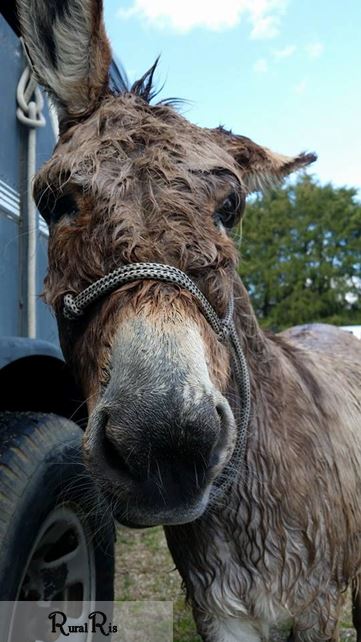
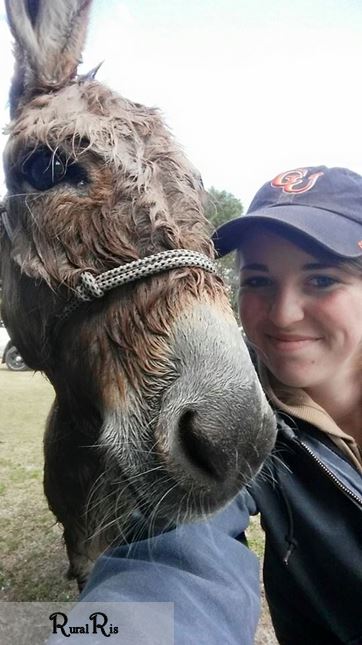
Yesterday, I caught April and washed her. She was none too pleased at being wet. I must admit, it was a little nippy. She did enjoy the scrubbing part, though. I made sure to hit all of her itchy spots. After getting all of the hay and dirt out of her coat, I tied her up to dry. Her friends, (Mirage, her grown daughter, and Firefly, our little rescue pony) lined the fence to watch what all was going on. Every now and again, April would stomp her feet in protest at the indignity she was enduring. Don’t let her fool you completely; she got treats galore. I locked her up in a stall for the night, so she wouldn’t get dirty.
The next morning was showtime. Garrett graciously agreed to drive down to be my chauffeur and assistant (he’s a great boyfriend). I was a bit nervous for the day, to be honest. I didn’t doubt that April would behave, but at the same time, she is an animal, and they have a mind of their own. I was just praying she wouldn’t relieve herself inside the church. Yes, April would be going inside the church–in the sanctuary. Now you see why I was a bit nervous (even though, the last time she held her bowels).
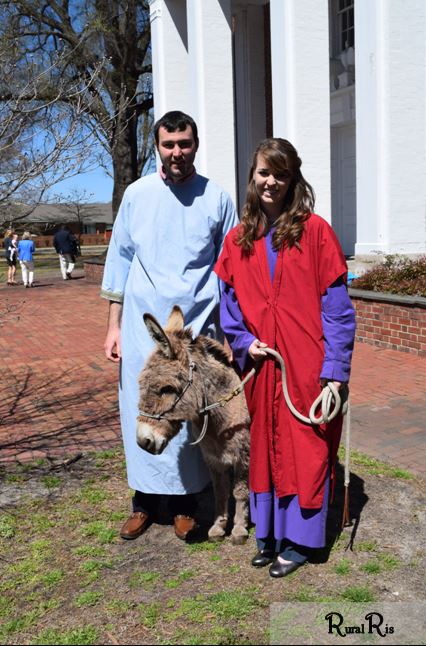
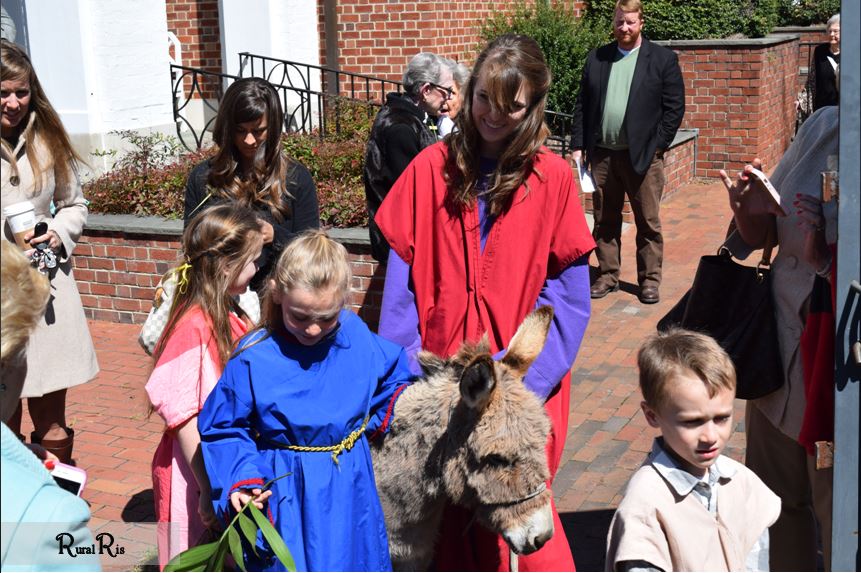
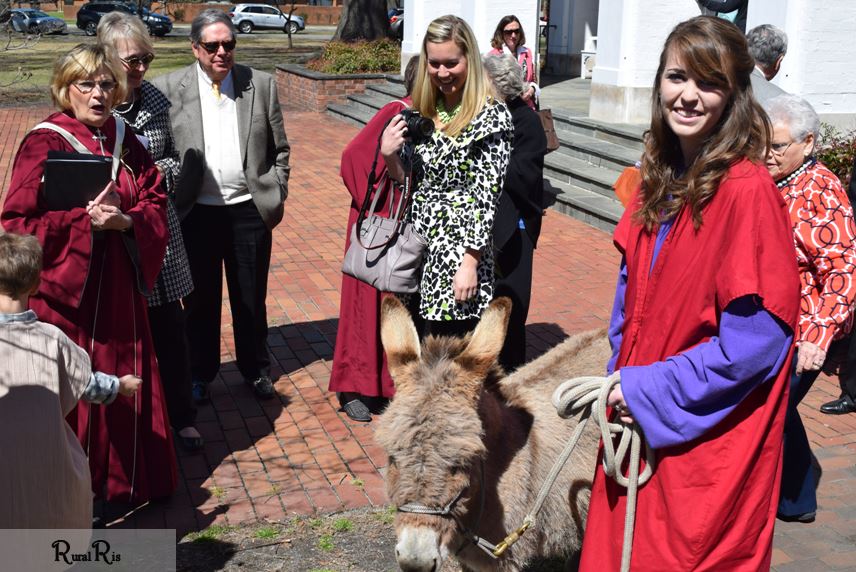
Upon arriving, Garrett and I met with various members of the church. They made us feel right at ease and were incredibly enthusiastic about us being there. That made me even more excited and definitely less nervous. They handed me a Biblical costume and asked Garrett if he wanted to dress up too. Garrett, being Garrett, is always up for anything. Amazingly, they found a costume that went below his knees (he is 6’7″ tall). After getting dressed, we walked through the route that we would be leading April down. She would walk up a ramp, through some doors, into the sanctuary, down the aisle and back out. Simple enough.
Garrett and I went outside to take April for a walk to get the jitters out of her. She let out one bray to announce her presence, but was very quiet otherwise. We slipped her carrots here and there for reassurance. I think she thought it was worth it for the orange sticks.
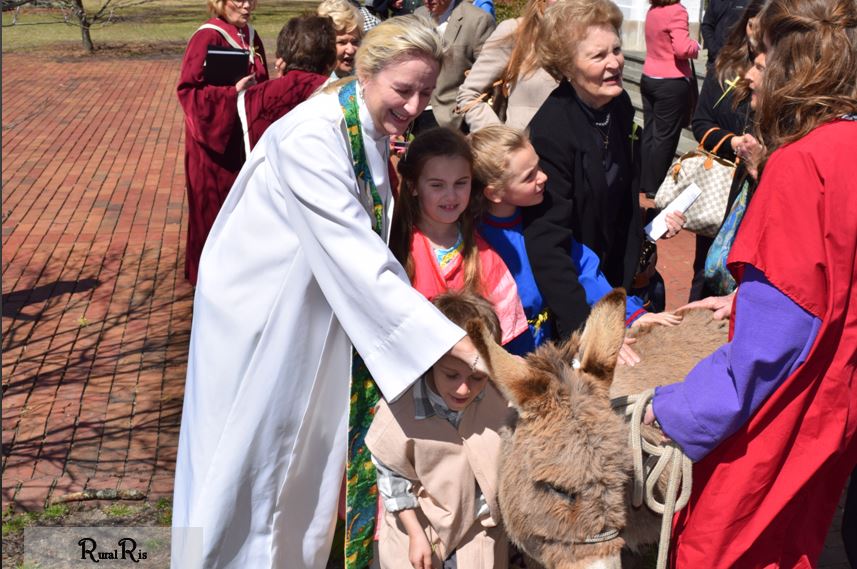
Soon, it was time for her grand entrance. I walked her in the doors to a foyer area. Inside were a lot of excited children dressed up, holding palm branches. April took it all in. She wasn’t entirely sure about the slick marble flooring, but didn’t make a big deal out of it, especially with carrots on her mind. Garrett stood behind her and slipped me carrots to give her. Music began to play, and our cue for entering began. We followed Rev. Leigh down the aisle as she laid palm branches as she went. April made me tug a little bit to get her in the large room filled with people, but soon pranced on. She cracked me up in regards to the palm branches. She dodged every single one, weaving in out of them, avoiding stepping on them. Who knew she would prefer red carpet over green leafy stuff.
The children filed in behind us and went to their places at the front of the church. April and I stood in front of them so parents could get a few pictures. One little girl came over to love on April while everyone was singing. When the song ended, Garrett, April and I walked back out the way we came. I breathed out a sigh of relief that I hadn’t needed to use the shovel in the trailer. No poop today. Hurrah!! We put April back in the trailer and slipped back in the church to hear the lovely sermon and the kids sing. It was really nice, and the sermon went perfectly with the presence of the donkey and it being Palm Sunday.
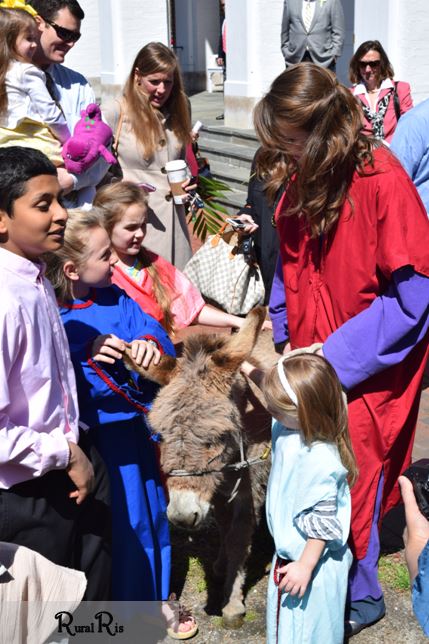
After the service, we took April back out so everyone could meet her. I could not ask for a more patient donkey. She was surrounded on all sides by people and a multitude of hands touching her at one time. She just stood there, looking left and looking right. Even when her tail got grabbed, she only took one step forward. She really was perfect.
I was so glad the day turned out to be such a success. I had faith in April (otherwise I wouldn’t have brought her) but she being an animal, you never know. I was most worried about stinky accidents. All went well, and she smelled nice from her bath. She made a lot of people smile, and made a timeless and poignant story come to life. She even got a few carrots out of the deal.
I think one of the things that resound with people most is the presence of the cross on April’s back. Legend says that the donkey that carried Jesus into Jerusalem on what we now call Palm Sunday, loved him so much that the little donkey followed Jesus to Calvary. Filled with grief at the suffering of his Lord on the cross, the donkey turned to leave, but could not. It was in that moment that the shadow of the cross fell upon the donkey’s back. Ever since then, donkeys have borne the mark of the cross as a reminder to us all what Jesus did for us on that day–died so that we may go to heaven. April, like many other donkeys, share this same symbol of love.
I hope you all had a wonderful Palm Sunday; however, I’m not sure it could get much better than mine. I am so grateful for the folks at First Presbyterian for making us feel welcome and exhibiting such excitement. I am glad I got to be a part of such a special day.
I hope you remember the legend of the donkey, especially as Easter approaches.
This week was Ag Awareness Week at school (NC State University). In the common area of the brickyard, where a lot of students congregate, were booths and displays set up spreading awareness about agriculture. There were live animals, tractors, and ag students available to answer questions. It thrills me that this event takes place. What a great way to educate and advocate for agriculture!
But, I have an issue with Ag Awareness Week. There shouldn’t be a need for awareness about ag. Let me say that again. There should NOT be a need for ag awareness. Sure, less than 2 % of the population are farmers, but those are not the only ones who should know about ag.
Why is it that in today’s society, school systems require kids to take mandatory classes in English, math, science, art, and history, but not agriculture when they partake in it 3 times a day at the table? Elementary and beyond, even in universities, agriculture is not among the forefront subjects of education. This is truly bizarre to me if you consider the prevalence that agriculture plays in our day to day lives, community, and economy. Think about this:
Food, regardless of type, is needed for human survival. That food comes from some type of agriculture (large or small).
America’s net farm income for last year, 2014, was $108 billion. (source)
22 million people work in agriculture related fields. (source)
There are over 200 available careers in the agriculture industry. (source)
Aside from the fact that food comes into play in our day to day lives, the influence that agriculture has on our economy and the job market is pretty astounding, and yet, we are not doing a sufficient job in our education system of educating our kids about these opportunities nor its impact. We are failing our kids in the ag literacy front. They may be able to read, but they can’t read ag.
Yeah, sure, schools have classes available for students to take about agriculture. We have ag teachers in schools and whole ag degrees in college, but it is optional for kids. English, math, history, art, and science all have special teachers for their respective subjects, and you can major in them in college, but they are also mandatory at some level in our kids’ education. The previous subjects like math and English are so valuable to a child’s proper education because they will utilize most of it on a day to day basis. So, why, if agriculture is enjoyed at least 3 times a day, is it not mandatory for a child to learn about where their food comes from and how it is made? In my opinion, this is a serious oversight and tragedy that our society is experiencing.
Because so many students go through elementary school, middle school, high school, and even college without gaining much of an understanding about the agriculture industry, they are missing out on valuable job opportunities, career paths, and the foundations of making educated decisions about what they eat. They never go through life appreciating what farmers do to feed a growing population. People grow up either not thinking about where the food they are consuming comes from, or developing misconceptions about farming in their heads. If and when they are finally exposed to real agriculture and farming, they are often shocked, and this has led to a lot of controversy.
Even worse, is that it is a cycle. Adults are ag illiterate and do not understand it, and then go and pass that on to their children a lot of the time. I have helped with Farm Animal Days in the past and observed mothers tell their kids to look at the puppy I was holding. In reality, I was holding a baby goat. The sad truth was they didn’t know the difference even with a college degree. Potentially more heartbreaking, was watching parents snatch their children’s hands from touching some animals or even dirt, to prevent germs. Animals can get pretty gross sometimes, but they aren’t toxic. I have had an individual in a restaurant ask what I had in the trailer in the parking lot. When we told her it was a pig, she wanted to know if it was big or small. We said it was a smaller pig, weighing around 230 pounds or so. This was a shock to her. People don’t realize pigs get twice that size.
My point in all this is that our society is generally illiterate. I’m not talking about the kind where you can’t read. I’m talking about the kind where you can’t read an anti-farming article and be able to pick out some of the discrepancies. I’m talking about the kind of illiterate that cannot distinguish a goat from a puppy or know how big a pig can get. An illiteracy that does not realize what contributions agriculture makes on the economy and the job market, and that there are opportunities besides being a farmer that are available in the agriculture industry. Beyond even that, many kids are missing out on valuable character building that farming provides such as responsibility, hard work, and ethics. This isn’t to say they don’t receive these character building traits from other places, but farming provides another avenue for it.
Because of this illiteracy, we are forced to hold Ag Awareness Week and recognize Ag Day that promotes more ag literacy. Guys, we shouldn’t have to have these special weeks and days to create awareness. It should already be there. Education should recognize agriculture as a subject that holds equal importance to art, math, science, and English. After all, everyone needs food. Until that happens, though, I say rock on to Ag Awareness Week. Keep up the good fight in educating, and maybe one day, we will live in an ag literate society.
When you live on a farm, there is always something new and a surprise around every corner. I feel like I shouldn’t be surprised when the unexpected happens, but I always am. It is one of the reasons I love living on a farm. No “one day” is the same. Last night, at 1:30 am, once again, I was surprised.
I had just finished painting my nails and watching a movie with Mom, while I finished up some homework (multitasking at its finest). Miracle still needed to be fed her last bottle of the night, so Mom got the bottles ready. She said that she would feed Miracle since my nails were wet, but asked if I would walk with her (keep in mind it is 1:30 am). At this point, let me give you a visual. I am in sweatpants, and my brother’s oversized Croc shoes. Mom is still in church clothes and bedroom shoes. We didn’t bring a flashlight, and Mom was confused as to why I was bringing her down a back way to the goat pen. Quite the picture right?
As we bent down to give Miracle her bottle, I looked to my left in the pen beside us. I started squealing. There in the dark, glowed a new baby goat. Not just any goat, but our Angora’s baby!
Note: In 2009, I bought 2 angora goats as a start in my fiber herd (Angora goats have long locks of fiber called mohair). We went all the way to West Virginia to get them. Many years ago, one died, but my other one has stuck around. She is quite the awkward goat, losing one horn a couple of years ago, and has stretched out skin. She has been very susceptible to parasites over the years, and has come back where most goats wouldn’t. She often has patchy hair, and always looks like a misfit, but she’s tough and quirky.
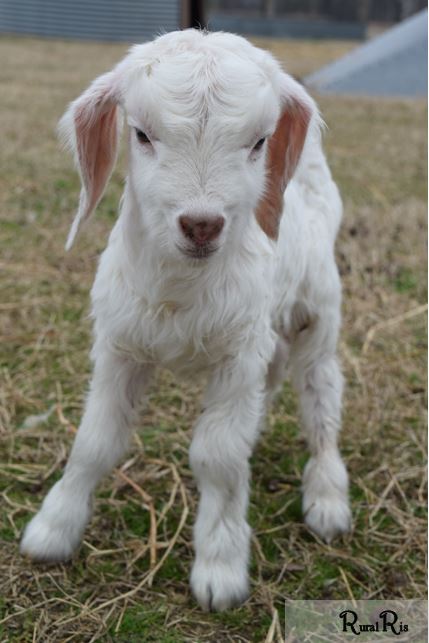
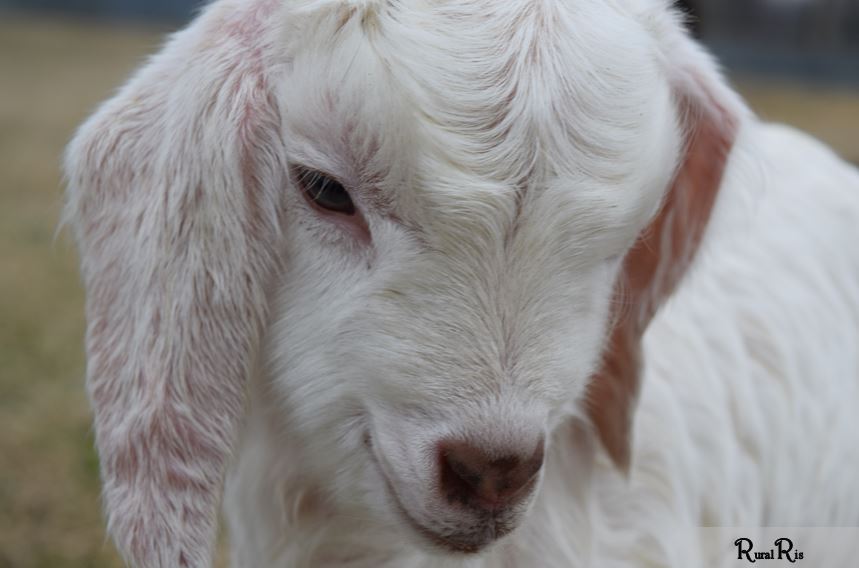
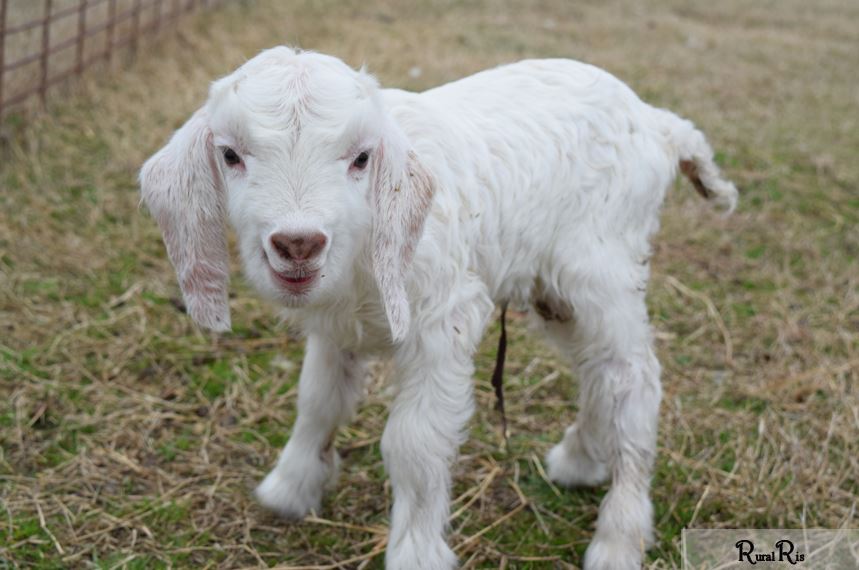
I ran to the house (as fast as the too big Crocs would allow me) and grabbed a flashlight from Alec’s room. He woke up, and I told him Angora had a baby! Then I left. I ran back outside to see a snow white baby goat standing beside the Angora. I almost peed on myself because I was so excited. I checked to see if it was a doe or buck, and it was a little girl. That made me squeal all over again. Mom is still incredulous as to what is happening, thinking it had to be Cash, Miracle’s brother that got into the other pen. Nope. It is a brand new baby.
We began forming a plan to get the new momma and baby situated for the night. We wrestled drop cords, and hung a heat lamp in a shelter. Keep in mind, Mom is still in a dress trying to do this stuff, and I’m slightly hyper. Finally, we got it all situated. We led the pair into the shelter and started to trim the Angora’s fiber so the baby could find the teats. The baby was so spunky, but was still having a hard time locating where to nurse. She went from the chest to the butt and back again. Finally, with a little direction, we saw her nurse. At this point, Angora was quite fed up with us and wanted us out. At 2 am, we decided that they would be fine, and we needed to go to bed. The goats were fine, but my nails were a bit worse for the wear. I don’t know why I even try.
This morning, Mom and baby were doing great. The baby is already running and jumping. I don’t think I’ve ever had one hit the ground with such spunk before. Angora is being a terrific mom too! We are still in the naming process, but are leaning towards Lunar Illusion and calling her Lilly or just plain Illusion and calling her Illy or Lucy. I’ll let you know.
I’m sure by now you think I am a crazy person for squealing and getting so excited. What you don’t know, is that for 5 years, the Angora has been in with various bucks, and never bred. Not only this, but 7 years is super old for a goat, so the chance of her catching now, of all times, is incredible. We honestly thought our eyes were playing tricks on us in the moonlight, but no, it wasn’t an illusion. We now have a Boergora goat (Boer/Angora cross).
Wonders never cease to amaze here at Countryview Farms. I’m still in awe over what happened and how spunky she is. Miracle isn’t the only miracle around here anymore!
This is a post from my old blog I wrote 2 years ago. I hope you celebrate agriculture today and everyday.
Today is National Agriculture Day. It is a time to celebrate agriculture all over the nation and bring attention to its many great qualities. Agriculture benefits all of us and is such an important entity in our country and world. Here are a few quick facts that show how beneficial it is and how astounding the industry is:
On average, every hour, 24 hours a day, 365 days a year, around $6 million in U.S. agricultural products–grains, oilseeds, cotton, meats, vegetables, snack foods, etc., will be consigned for shipment for export to foreign markets.
It all means more jobs and higher wages across the nation. U.S. agricultural exports generate more than $100 billion annually in business activity throughout the U.S. economy and provide jobs for nearly 1 million workers.
Twenty two million American workers produce, process, sell and trade the nation’s food and fiber. But only 4.6 million of those people live on the farms– slightly less than 2 percent of the total U.S. Population.
Consumers spend $547 billion for food originating on U.S. farms and ranches. Of each dollar spent on food, the farmer’s share is approximately 23 cents. The rest are for costs beyond the farm gate: wages and materials for production, processing, marketing, transportation and distribution.
These are astounding facts. Most of us have seen the Super Bowl commercial “And God Made a Farmer”, which gives insight into the world of those who work in the industry. For me, though, agriculture is much more personal than having food on my table. It has been a part of my entire life and has instilled in me so many qualities. You see, for me, it is not just about the product and the benefits for the country, but about how agriculture has shaped my life.
I can say that agriculture has been in the family for generations. My grandpa and great grandpa were crop farmers, and we now live on the same land they farmed. Mom helped with tobacco and had livestock growing up, and Daddy worked on a turkey farm. When I was little, I can remember Daddy bringing home an orphan calf for a day just so I could see it. I would go to work with him and bottle feed a calf or slide down the piles of cotton. Poor him didn’t know what to do with a 3 year old little girl who needed to use the bathroom on the dirt roads of the middle of no where, though. Anyways, this was images of my early years; however, we lived in city limits and couldn’t have any livestock and only had a vegetable garden and dogs. In my 4th grade year, though, my life would change for the amazing.
We moved out to the family land that was across the road from my grandparents. Within the first year, we had gotten 4 goats and started showing them. That was a start of a passion and journey. Those 4 goats grew into a herd of 30 that I learned to manage myself, eventually. I learned how to trim hooves, give shots, birth babies, feed, recognize disease, and so much more. At 9 years old, I learned what it was to get my hands dirty and developed a passion for agriculture. I was always trying to increase my knowledge and animal count (let’s be honest). Goats were not the only thing I got into. I was soon showing pigs, turkeys, and horses from local to state. It was always a family affair going to fairs and shows. Agriculture has created a closer bond with my family. There have been countless dinner conversations about when to wean goats, how much weight the pigs can gain, and if we need more feed (we are always needing feed). My little brothers have started an egg business, now, and I have gotten into sheep and using their fiber. Make It With Wool allowed me to travel nationally and share my love of part of the agriculture world– sheep and wool.
It wasn’t just good things on the farm. Having livestock is hard. Goats getting out, fixing fences, mucking stalls, and feeding in the rain and mud were the less glamorous part of it all. It was also, though, seeing animals get sick, babies not make it till morning, and the disappointment in all your efforts, still not being enough. It isn’t all glitz and glam. It can be hard, but it so worth it. Walking into the show ring, seeing babies being born, or watching the animals get frisky in good weather makes you smile.
Agriculture has gone beyond the farm for me, though; it is also been in contests such as livestock judging, skillathon, and quiz bowl. Doing these contests through 4-H has increased my knowledge, allowed me to meet people, travel, become a good sport, and public speak.
That all being said, and there is so much more that could be said, agriculture has been a huge part of my life. It has taught me hard work, responsibility, public speaking skills, good sportsmanship, and so very much more. I have become closer to my family and met some wonderful friends. Agriculture puts food on the table, helps the economy, and provides jobs, but it has also benefited me in more ways than I can count. It is a part of me and will be in the future. Hopefully I will be able to find a career in agriculture, promoting it and being a communication person for it. So, here is to agriculture. Let’s celebrate this unique and amazing industry.
This slideshow requires JavaScript.
Facts retrieved from NCSU College of Agriculture and Life Sciences
As many well know, tomorrow is St. Patrick’s Day. If it has slipped your mind, then I suggest quickly changing your wardrobe plans to include wearing green. I would hate for you to get pinched. Now that we have gotten the obvious out of the way, how about a few facts about St. Patrick’s Day that you may have not known.
St. Patrick was actually a British guy not Irish. He was kidnapped as a teenager by Irish raiders and brought to Ireland. He ended up staying in the country, even after escaping his captors, to be a missionary.
Green is not the original St. Patrick color. Originally, the saint’s color was blue. Green came about due to the connection with Ireland and shamrocks.
Speaking of shamrocks, St. Patrick used these to tell the story of the Trinity. Later, Irish used the clovers to stick in their lapels as a form of national symbolism. So, there aren’t any four-leaf clovers on St. Patrick’s Day.
Corned beef and cabbage are really an Irish-American deal. To celebrate the special day, Irish-Americans would splurge on a special meal. Brisket was the cheapest meat and cabbage was a cheap vegetable, giving us the traditional St. Patrick’s Day meal.
Mythology says that St. Patrick drove all of the snakes out of Ireland, but in reality, Ireland never had snakes in the first place.
The first celebration of St. Patrick’s Day was in 1762 in America.
For the first several years, all bars were closed during St. Patrick’s Day because it fell during Lent; this was lifted in 1961
The Chicago River will get 45 pounds of green vegetable dye dumped in it this year during St. Patrick’s Day
St. Patrick’s Day has been celebrated in space twice. The most recent was by Chris Hadfield in 2013.
Traditionally, leprechauns are only male. There are no girls.
So, there you have some facts that I bet you didn’t know. My family will be celebrating the day with green dyed food. There is such a thing as green eggs and ham at my house, at least for one day.
When Mom would tell my brother and I to go play outside, one of our go to things was explore the woods that edged our property. The woods were always a magical place, full of adventure and lots and lots of briers. We would discover animal tracks and pretend to be explorers. On one of our many explorations, we discovered an old house.
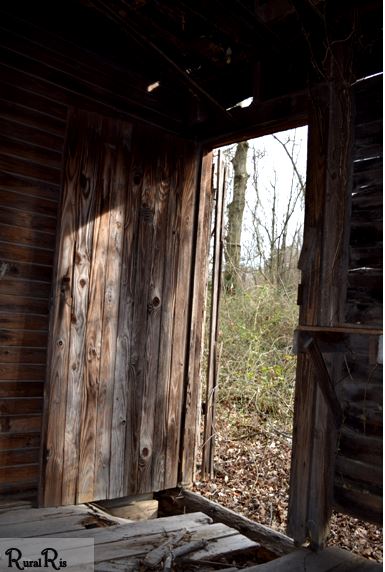
It wasn’t some mystery house that no one knew about. My grandpa used to know the lady who lived there, but to my brother and I it was a domain filled with wonder and adventure. The old house had been abandoned for 20 years after the woman living there had died. Inside, there was still some of her dishes, an old fridge, a bed, and so much more. Most of the windows were still intact and you could still walk on the floors, though one side sagged.
My brother and I always felt some sort of reverence when perusing the house. At a point someone lived there, and left behind were the earthly belongings she could not bring with her. To children, the house was filled with mystery. We could only conjure images of the way the house used to be from our imaginations. Oftentimes, we discussed if we would find forgotten treasures (we never did and wouldn’t have kept it anyway). Adding to our wonder were words written on one of the walls. There, written in pencil was the name of my grandpa and his telephone number. To a child this might as well have been the discovery of Egyptian hieroglyphics. We were so excited and ran to tell my grandparents about our find.
Over the years we explored the area around the old house, discovering a well that we were strictly forbidden to go near. We also explored another abandoned house in the woods at my grandparents. This one had been abandoned since the 60’s and was too far gone to enter. Instead, we would peep in and use it as a backdrop for photos.
The old houses always held a certain allure to me. They were my castles in the country. We made sure to share the fortresses with my two younger brothers as well, and they dubbed it Monster House after one of their favorite movies. Just as it had for my older brother and myself, the old houses captivated and intrigued my youngest brothers too. It is a special part of our childhood–being able to step back in history.
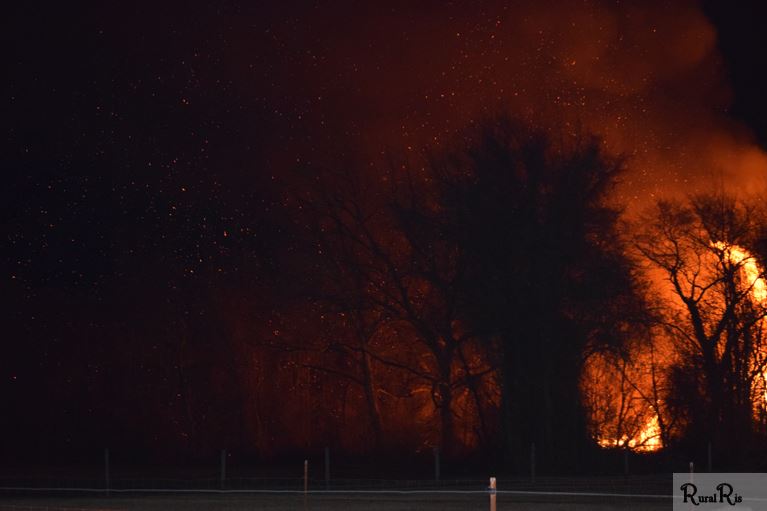
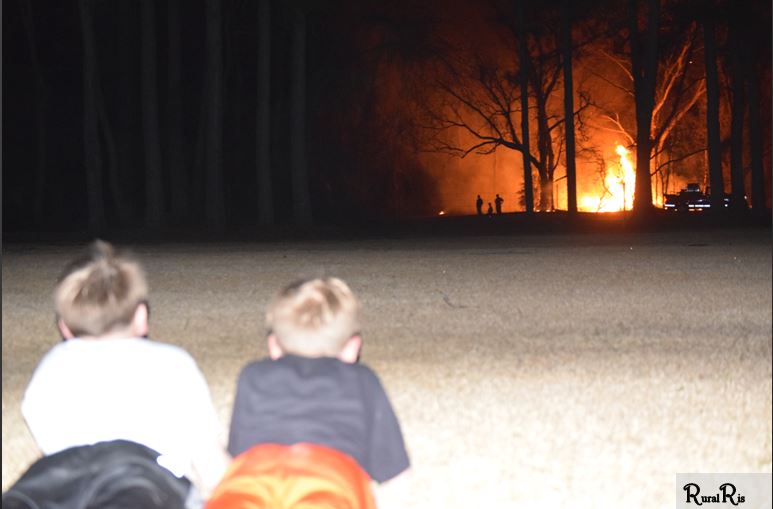
Last night that history was laid to rest in a display of fiery inferno, providing one last mystical show for my brothers and I. The owner of the houses decided it would be best to allow the local volunteer fire department to receive training practice and burn the buildings. In this way, the houses wouldn’t pose a threat to anyone as they further dilapidated and would also give the fireman in the community a chance to practice their fire fighting skills. It also gave us quite the show.
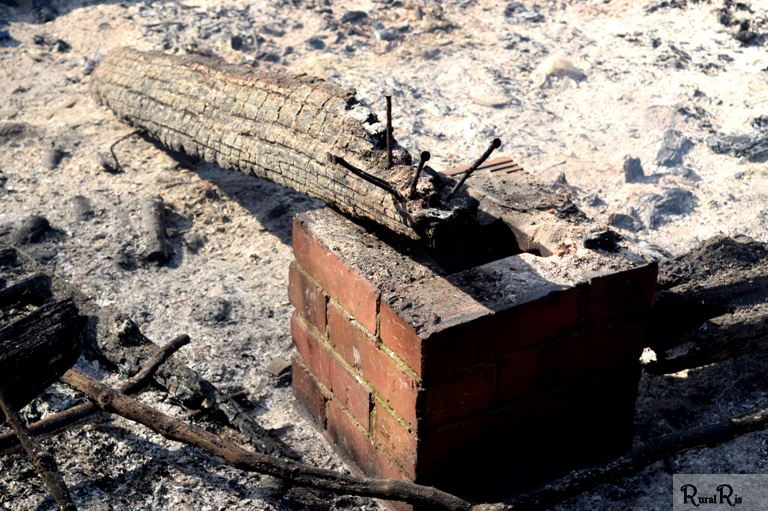
Last night we said good bye to old friends. Gone is the childhood mystical fortress that held such wonder. In its place stands a lone brick fireplace and the memories of days gone by.
We all know what this looks like. Sure there are many different types of girls, but a girl is a girl– xx chromosome plain and simple. For me being a girl means being able to wear dresses. It means makeup and heels. Being a girl means I give directions via landmarks and eat chocolate as stress relief. I am prone to bursts of emotional breakdowns and like to talk about my feelings, but I am also more than a dressed up emotional female. I am, and always have been strong-willed and independent. When I was two, my dad put me in time out and told me not to get out of that chair until he came back. When he came back, I was clear across the room. I hadn’t gotten out of my chair, I had taken the chair with me and scooted to the spot I wanted. Dad laughed and said that I was going to be trouble.
I am opinionated and at times a little cold-hearted, much to my mother’s chagrin. I am smart, competitive, sassy, and classy. Being a girl means that I have the joy to be a daughter, granddaughter, sister, girlfriend, and hopefully, one day a mother.I embrace being a girl and all of its feminine qualities–even in farming. For me, it is feminine farming.
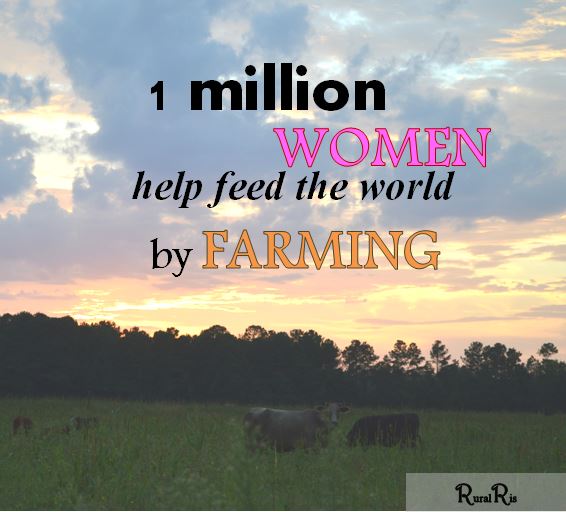
Feminine farming looks different for every woman out there who farms. In case you were wondering, that is 1 million lady farmers. While each one is different, they all share a common goal of feeding the world, and I am one of them.
For me, feminine farming has evolved in the 13 years I have lived on a farm. I started with a “I have something to prove” attitude, always wanting to show up the boys. If they were lifting feed bags, I wanted to lift just as much. If we were wrangling goats, I wanted to be the last one to back down. So many times, my dad and grandpa would fuss at me for not letting my brother or them take care of it. I didn’t want them to take care of it, because I knew I COULD do it. I was missing the point that I SHOULD NOT necessarily do the heavy lifting that the guys were more capable of doing.
I won’t lie, that mentality is not in the past. It still comes up and I have to remember that my 6’4″ brother is better equipped to move the huge stack of 50 pound feed bags than I am. That doesn’t mean I don’t do things. I still get muddy, poopy and gross. I wrestle pigs and goats. I can drive a nail and work power tools to fix the fences and pens, but I have also embraced my more feminine side when it comes to farming. My muck boots are pink, and my jeans have bling on them. Sometimes, I have to run out in the pasture in heels to get a goat’s head unstuck. Somehow, I still can’t back a trailer like the boys can, so I let them deal with that.
Just because I am a farmer, does not mean I wear coveralls, and have manure on me all the time (only when required).
Just because I am a girl, does not mean that I am helpless in the barns. Because I am a girl who is a farmer and enjoy partaking in feminine farming, I bring a little pink in the barn. I like to hold “conversations” with the animals and cuddle the newborns, naming everything that comes on our property. I let the guys lift the feed bags when they are there. I like to dress up and wear heels, but I’m not afraid to go rescue an animal in those heels. I curl my hair for livestock shows and wear the sparkliest belt I can find, even though, I may be wiping a pig’s butt at the same time. I paint my nails, even though I know it will only last a day after working outside on the farm.
I am a girl. I am a farmer, and daily I practice feminine farming.
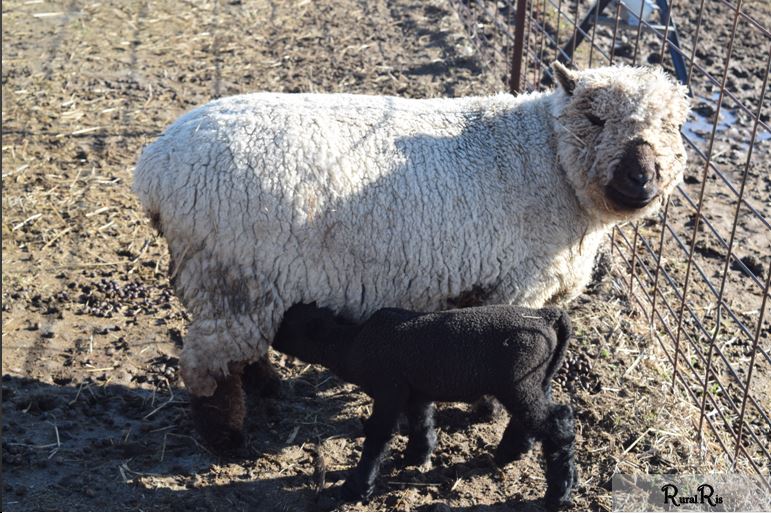
If you have not met Grover, here is our little Southdown/Leicester cross lamb.
Isn’t he just the cutest? I thought so too 🙂
Today Grover, like any lamb on our farm, got his tail docked. Docking a sheep’s tail is not simply for aesthetic reasons, it has health reasons too. It isn’t cruel, but rather, it is beneficial to the animal.
Why do we dock?
It isn’t because the tail looks a little funny, although, I must say, it does look funny.
If the tail was not docked, the wool that grows on the tail would become caked with feces and urine. This isn’t just gross when it comes to shearing time, but it also is unsanitary for the sheep and can cause irritation. In addition, docking also reduces the chances of fly strike, a painful condition caused by blowflies laying eggs in the fleece and the maggots burrow into the sheep’s flesh. The sheep often dies within a few days of fly strike occurring. Some studies have also shown that docking tails increases growth rates. For these reasons, we dock the lambs’ tails within the first week of life. Some sheep do not necessarily need to have their tails docked. Hair sheep, do not have the thick wool, and it does not pose as much of a problem.
How do we dock?
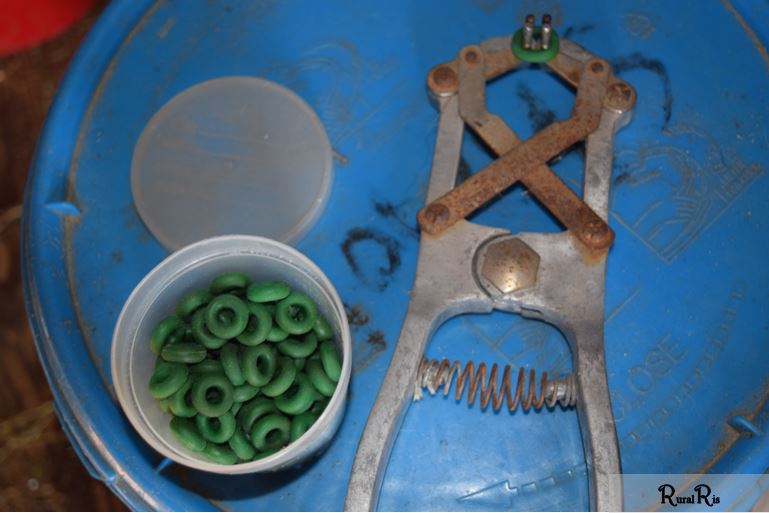
There are different ways to dock a lamb’s tail. We use an elastrator (we also use this to castrate).
The elastrator tool puts a thick rubber ring or band on the tail, cutting off blood circulation. Around 10 days later the tail falls off. It is inhumane to use the elastrator on older lambs, which is why it should be done after 24 hours old but not after 1 week. Another tool to dock is an electric docker.
This tool cuts and cauterizes the tail simultaneously. It can be done in older lambs, but it is still best to do it on young lambs.
Are there negatives of docking?
Yes, if done incorrectly. It is important when docking lambs to not make the tail too short. If the tail is too short, it increases the chances of a rectal prolapse.
I’m making sure to leave a certain amount of tail.
Does it hurt?
A little. The younger the lamb, the less stress it causes, though. When we put the band on Grover’s tail, he did a little butt wiggle, and went straight back to mom. He acted like nothing was wrong. We have had some lambs be a little more sensitive, and act like there is something on their butt, which there is. They are always fine within the hour, though.
A quick drink from mom is all Grover needs
Is docking tails inhumane?
No, it is not. I have read where some people think that farmers have bred sheep to be unnatural in their wool production, and that is the only reason that we have to dock tails. While there are different breeds that have various kinds of wool, sheep naturally have wool. Farmers did not breed sheep to have an excess of wool. Those in the wild, do not have the same type of fiber as a domestic sheep, and do not even need to be sheared. For thousands of years, sheep have needed to been shorn for their fleece. It isn’t a new phenomenon caused by selective breeding. Farmers breed for quality of wool and quantity, but regardless of the quantity, any amount of wool on the tail will cause unsanitary conditions. While docking may cause some discomfort, it is often no more uncomfortable than getting a vaccination shot.
Docking is beneficial to the lamb. It is not just for the farmer’s sake, but also the animals. Grover did not seem to mind one bit about his procedure. He didn’t cry or really squirm. I think he was more concerned that his mom was calling for him and we were touching his butt. He was just dandy.
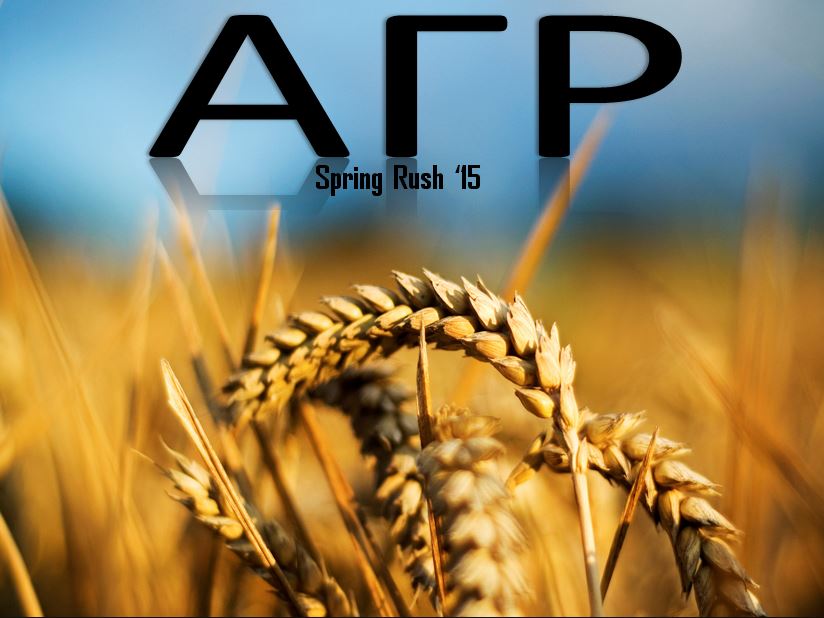
For the past two years, I have had the privilege of getting to know the great group of guys that belong to the Alpha Gamma Rho (AGR) fraternity at North Carolina State University. I was introduced to them through my boyfriend, Garrett (for a post on what dating a fraternity guy is like, her is the link) who is a member of the fraternity.
What I love about this group, is they aren’t your typical fraternity. Sure, they like their tailgates and bow ties like any other good fraternity man would, but they also all have a common interest and passion in agriculture. So, while they are bonded in brotherhood, and all of have the commonality of being in college together, they are also bonded through agriculture. They don’t all have the same interests. Their majors include agriculture education, biological engineering, animal science, poultry science and everything in between. Some come from backgrounds of sweet potatoes and others come from pigs and cows. One thing is certain, they all love ag, and are all dedicated to both their fraternity and to the agricultural industry.
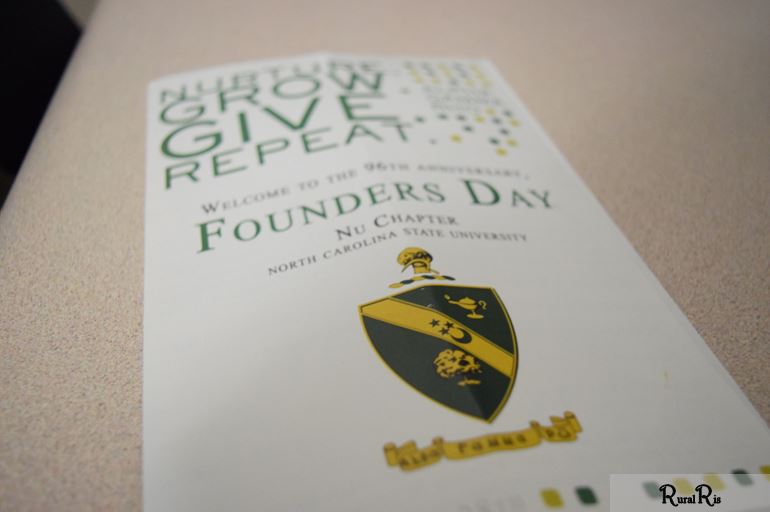
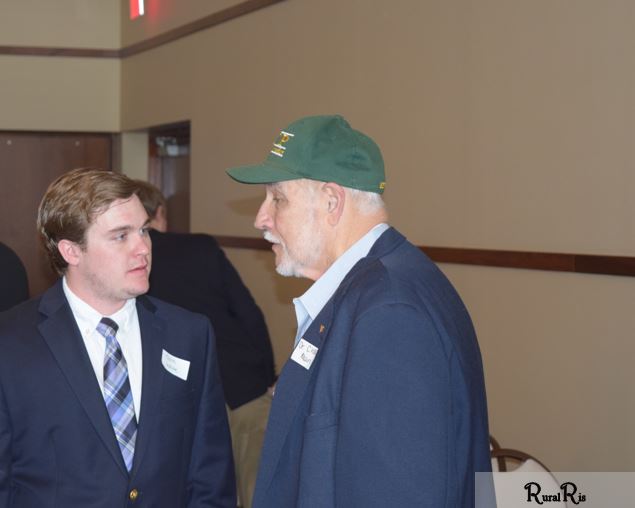
This weekend, AGR had their annual Founder’s Day banquet. This is an event to bring together AGR alumni from years past, current brothers, and families of the brothers. It is a special day for all of the guys as they review both their struggles and achievements of the past year and share that with the alumni and their families. It only takes a few minutes in that room to know that the AGR men are passionate about their organization, each other, and an agricultural future.
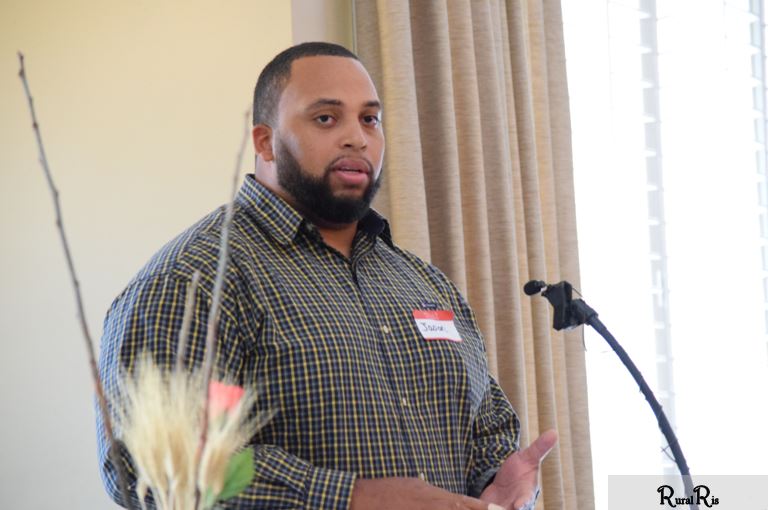
At the luncheon, there were two guest speakers–Jason Brown and Bryan Blinson. Jason Brown is a former NFL player, who has recently retired and turned to farming. Jason has gone from the football field to the farming field and is loving the change. He has a passion for growing food and then donating it to those who are hungry. Jason was very honest with the group that he was not an experienced farmer. He was still learning and was doing all he could to learn. The AGR guys announced that they planned on going to his farm and volunteering an entire day’s worth of work to help Jason. After the event was over, I heard many vocalize how excited they were in helping out.
Jason Brown
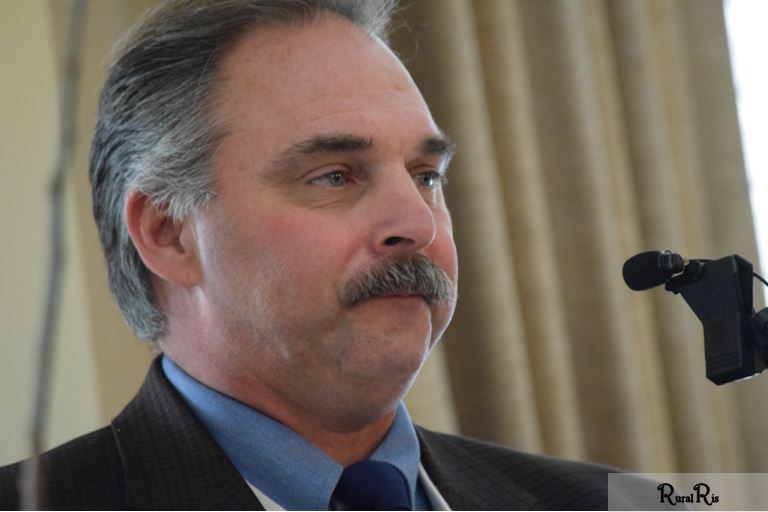
The second speaker is also a local farmer. Bryan is heavily involved in the cattle industry and an AGR alumnus. He reminisced about his AGR experiences and all that it meant to him. Something that stuck out to me was when Bryan highlighted the uniqueness of AGR. He explained that in other settings, he was the only ag guy, and would get picked on, but when he joined AGR, he was surrounded by like-minded people who all had the same interest. AGR was not your typical fraternity.
Bryan Blinson
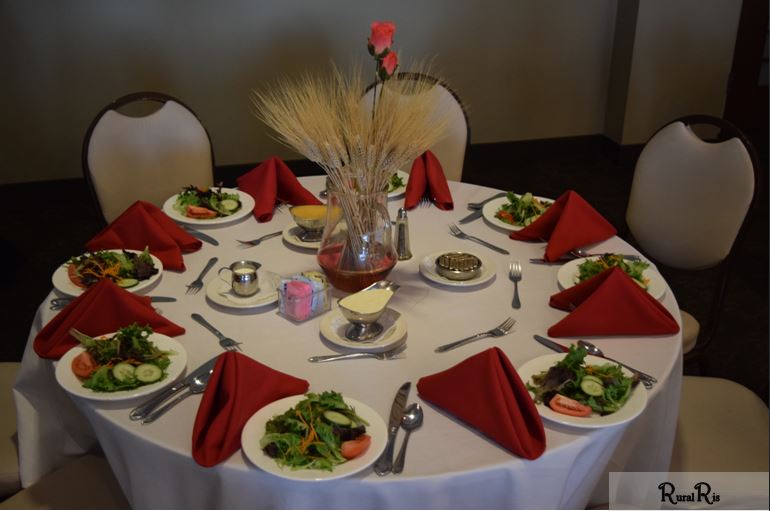
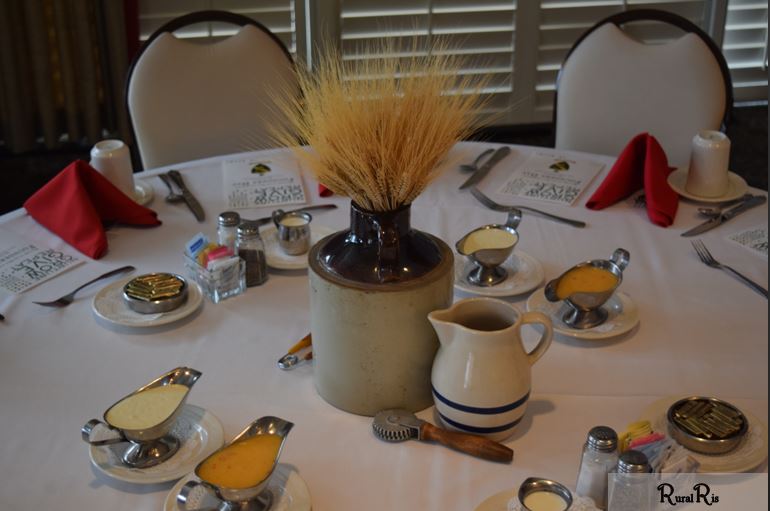
In addition to being able to get to know the AGR men and attend Founder’s Day, I was also able to have a part in making the event happen. I was excited to be organizing centerpieces and decorations. After many hours on Pinterest (because that is the only logical way to prepare), Garrett and I decided on an antique theme. His grandma has countless antiques, so we borrowed two boxes filled with kitchen utensils, churns, jars, and so much more. I ordered wheat (this is an AGR symbol) and there was also pink roses purchased (another AGR symbol). I went out with my brothers and cut sticks from the woods as decorations too. I was so nervous that it wouldn’t come together, but it all turned out great! The antique pieces turned into many a conversation piece. I’m very thankful that the guys let me have some creative fun at their event.
The guys of Alpha Gamma Rho are a stellar group of men who are already doing some pretty awesome stuff in the agriculture world. With the 3rd highest fraternity GPA at the university and an award for excellent financial management, they take their responsibilities seriously. They truly fulfill their mantra of “Making Better Men.” Thanks guys for introducing me to “not your typical fraternity”




















 Rural Ris